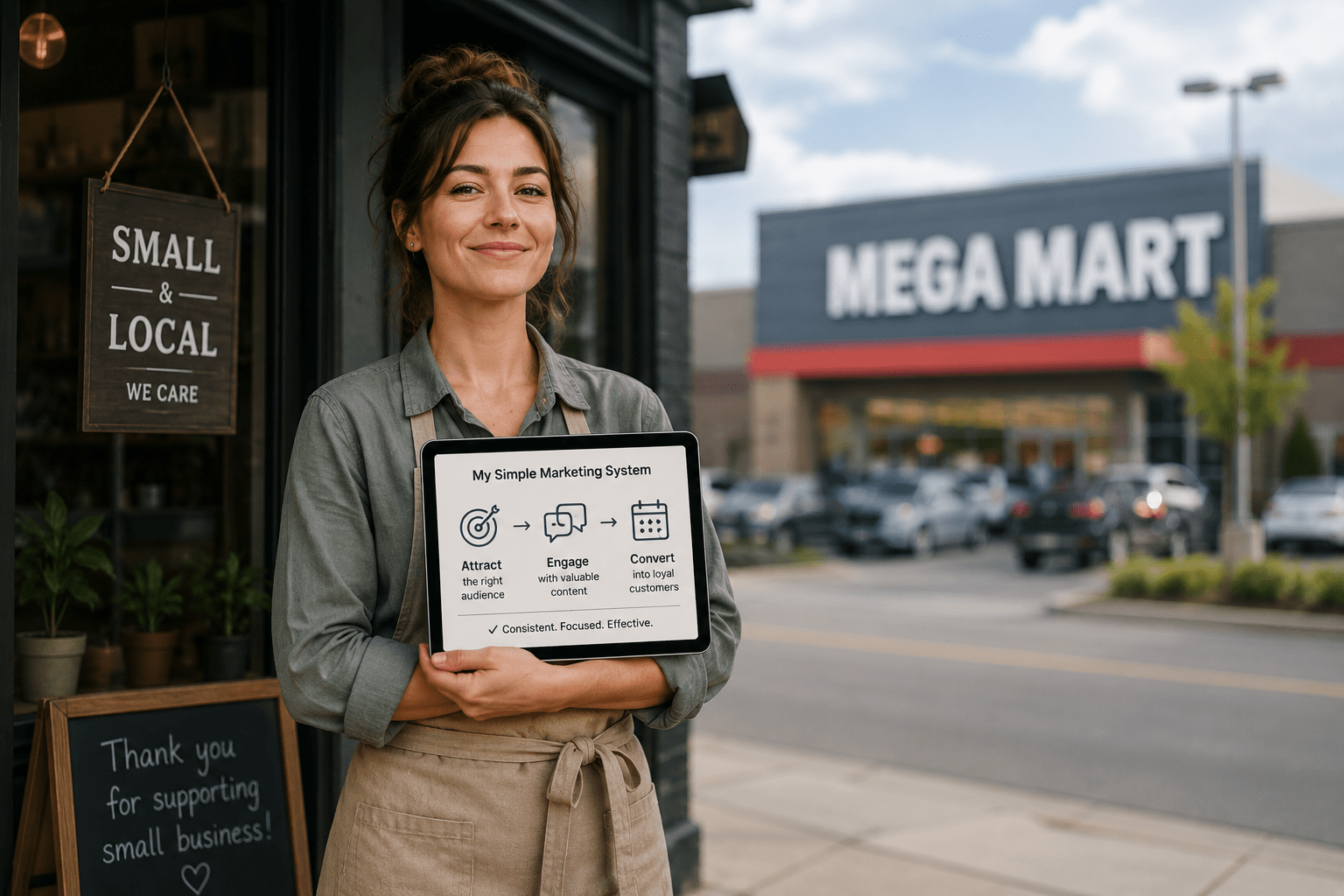
Big chains have big budgets, but local businesses have something better: personal connection. Digital tools amplify that advantage without requiring a chain-sized budget.
The impossible competition
A local bookstore competes against Amazon. A neighbourhood cafe competes against Starbucks. A family-run hardware store competes against Home Depot. On paper, this is an impossible competition. The chains have more money, more technology, more marketing reach, more everything. And yet, local businesses survive and sometimes thrive. How?
The answer is not that local businesses can outspend chains. They cannot. The answer is that local businesses can out-relate chains. Personal connection, local knowledge, community involvement, genuine care — these are advantages that chains structurally cannot replicate at scale. Digital tools, used correctly, amplify these advantages rather than trying to compete on the chains' terms.
Speed of response as a competitive weapon
A customer sends a question to a chain's social media account. It enters a queue, gets assigned to a support agent, goes through a script, and receives a response in 24 to 48 hours. A customer sends the same question to a local business owner who has notifications enabled on their phone. Response time: five minutes. The customer feels seen, valued, and answered. They choose the local business not because it is cheaper or better, but because it was there when they needed an answer.
This speed advantage is not expensive technology. It is a deliberate choice to be responsive. Set up notifications. Check messages regularly. Reply promptly. The chain cannot match this because their processes do not allow it. Your process is you.
The personal face versus the corporate logo
A chain's online presence features stock photography, corporate logos, and professionally written but impersonal copy. A local business's online presence can feature the actual owner's face, real photos of the actual location, and copy written in the owner's actual voice. The contrast is stark. People connect with people, not logos.
Put your face on your digital presence. Not a professional headshot in a suit if that is not who you are — a real photo of you in your shop, your cafe, your studio. Write your bio in your voice. Record a short video introducing yourself. These small touches cost nothing and create a connection that no chain can manufacture.
Local knowledge as content
Chains have national marketing departments creating generic content. You have lived in your neighbourhood for years. You know which streets flood when it rains, which school won the football championship, which park has the best dog-walking hours. This knowledge is content that chains cannot produce.
Post about local events. Celebrate local achievements. Share local tips. Your content will be genuinely useful to your neighbours in a way that a chain's generic post about a national holiday never will be. Local content attracts local customers, and local customers are your customers.
QR codes that bridge the physical and digital
Chains spend millions on integrated omnichannel experiences. You can achieve a smaller but effective version with a QR code on your window, your counter, or your receipt. The code leads to a simple page with your menu, your services, your story, and a way to contact you directly.
A passerby scans the code after hours, sees what you offer, and decides to visit the next day. A customer waiting in line scans the code, discovers a service they did not know you offered, and adds it to their order. The physical presence attracts attention; the digital page converts it into business. This is the same principle the chains use, executed simply and affordably.
Community involvement that cannot be faked
A chain sponsors a local event by writing a cheque and putting their logo on a banner. A local business sponsors the same event by showing up, bringing products, talking to attendees, and being part of the community. Both are sponsorship. Only one builds relationships.
Attend local events. Host local meetups. Offer your space for community gatherings when you are closed. These activities cost time but little money, and they embed your business in the fabric of the neighbourhood. A chain can open a store in your neighbourhood. It cannot belong to your neighbourhood the way you do.
Pricing that does not race to the bottom
Do not compete on price with chains. You will lose. They have economies of scale you cannot match. Compete on value instead. Your coffee costs more than Starbucks? Explain why: locally roasted beans, a recipe you developed over three years, a barista who remembers every regular's order. People pay more when they understand the value, and chains are bad at explaining value because they sell sameness. You sell uniqueness.
Display your pricing openly with a brief explanation of what makes your product or service worth it. Not a defensive justification, just a confident statement of value. Customers who choose on price alone will go to the chain regardless. Customers who choose on quality, experience, and relationship will choose you if you give them the information to justify that choice.