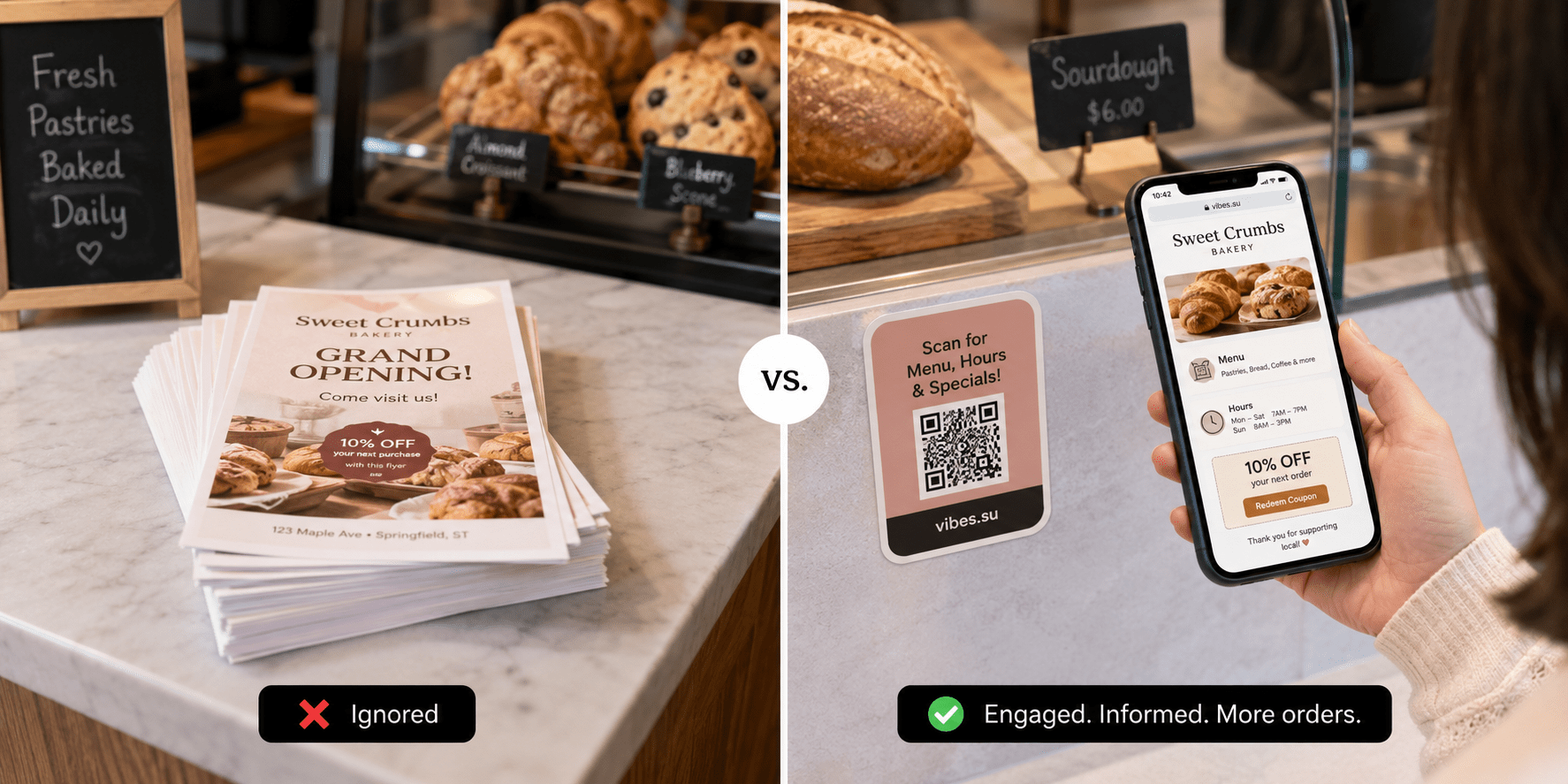
A bakery owner spent $300 monthly on flyers that ended up in the trash. She replaced them with a simple digital page and a QR code sticker on the counter. Walk-in traffic increased.
The flyer problem
Maria runs a small bakery in a residential neighbourhood. For three years, her marketing strategy was simple: print 2,000 flyers every month, distribute them to nearby mailboxes, and wait for customers. The flyers cost $180 to print and $120 to distribute — $300 monthly for a roughly 1% redemption rate. About 20 customers per month came in with a flyer.
Most flyers went straight into the recycling bin. Some sat in mailboxes until rain turned them into pulp. Maria knew the numbers were bad, but she did not know an alternative that a small bakery could afford.
The experiment
Instead of printing the next monthly batch, Maria invested one hour into setting up a digital alternative:
- she created a simple landing page in Vibes with bakery hours, menu, a photo gallery of baked goods, and a one-time coupon code for 10% off;
- she generated a QR code that linked to this page and printed it as a 15×15 cm sticker on the counter by the cash register;
- she added the same QR code to a small sign in the window, visible from the street;
- she posted the link on the bakery's local social media pages.
Total cost: $0 for the landing page and QR code, $12 for sticker printing. Instead of $300 and a weekend of walking around stuffing mailboxes.
What happened
Within the first month:
- the counter sticker was scanned 340 times — people waiting in line scanned it out of curiosity;
- the window sign QR code was scanned 120 times — mostly by people walking past after hours;
- the coupon code was redeemed 85 times, bringing in 85 new or returning customers;
- Maria could see exactly how many scans came from each location and which days were busiest.
The counter sticker was the unexpected winner. People waiting for their coffee naturally scanned the code, saw the full menu, discovered items they did not know the bakery offered, and added them to their order. The average order value from customers who scanned the QR code was 18% higher than walk-ins who did not.
Why this worked better than flyers
Flyers push a message to people who are not currently thinking about bakeries. A QR code on the counter reaches people who are already in the bakery, ready to spend. The timing is perfect.
The window sign QR code reaches people walking past when the bakery is closed. They scan, see the menu, and plan to visit the next day. A flyer cannot capture that intent because there is no immediate action. A QR code captures it instantly: scan, see, decide to return.
And unlike flyers, the digital page is updatable. When Maria adds a new pastry to the menu, she updates the page once. Anyone scanning the same QR code sees the current menu, not a printed version from three months ago.
The numbers after 3 months
- QR scans: over 1,200 total;
- coupon redemptions: 210;
- monthly marketing cost: $12 (sticker replacement every few months);
- cost per customer acquired: dropped from $15 (flyers) to under $1 (digital);
- additional benefit: Maria learned which menu items customers looked at most, helping her adjust the display case layout.
What this means for other small businesses
This approach works for any business with a physical location: cafes, salons, repair shops, clinics, gyms. The formula is the same:
- Create a simple landing page with the information customers actually want — not your company history, but your hours, services, prices, and a reason to act now.
- Put a QR code where customers are already standing: the counter, the waiting area, the mirror in a salon, the changing room in a clothing store.
- Give them a reason to scan — a coupon, a hidden menu item, a free consultation.
- Track scans and adjust the page based on what gets the most attention.
Maria still prints flyers, but only 200 now, and only for the monthly special event. Everyday marketing moved to digital. The $288 monthly savings goes into better ingredients.